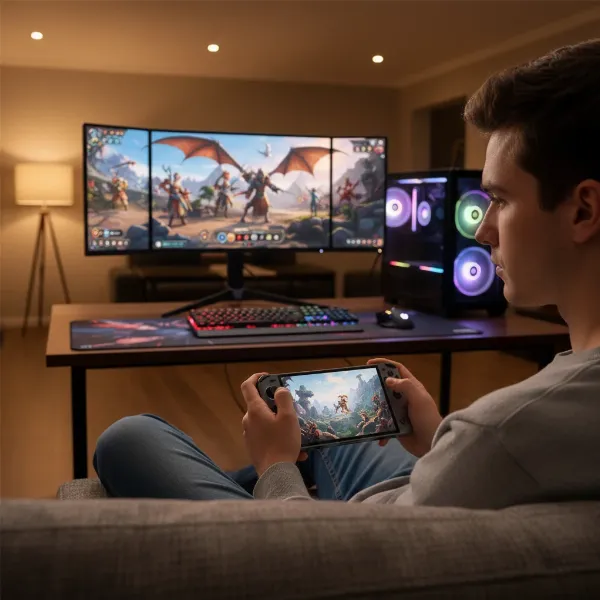
For decades, the world of video games has captivated enthusiasts, evolving from simple pixelated adventures to sprawling, immersive virtual realities. At the heart of this evolution lie two distinct pillars of play: the portable charm of handheld game consoles and the grandiose spectacle of arcade machines. While both offer unique avenues for escapism and entertainment, they cater to fundamentally different gaming desires. As you navigate the ever-expanding landscape of gaming, understanding the unique strengths and weaknesses of each platform is crucial to finding your ultimate champion. This article delves into a comprehensive comparison, examining their histories, technologies, and social impacts, to help you decide which experience truly wins your heart.
The Enduring Allure of Handheld Game Consoles
Handheld game consoles represent the pinnacle of personal, on-the-go entertainment, empowering players to carry entire worlds in the palm of their hands. These compact devices integrate the console, screen, speakers, and controls into a single, highly portable unit, allowing gaming virtually anywhere, anytime. From a quick commute to a long journey, or even just relaxing on the couch, handhelds offer unparalleled convenience.
The journey of handheld gaming began in the mid-1970s with pioneers like Mattel’s Auto Race (1976), which introduced simple LED-based electronic games. A significant leap came with the Milton Bradley Microvision in 1979, notable as the first handheld game console to feature interchangeable cartridges. However, it was Nintendo’s Game Boy, launched in 1989 and bundled with the immensely popular Tetris, that truly democratized portable gaming, establishing its place in popular culture. Subsequent innovations brought color screens (Atari Lynx, 1989), touchscreens (Game.com, 1997, and later the best-selling Nintendo DS, 2004), and internet connectivity, continually refining the mobile gaming experience. Today, the landscape is richer than ever, with Nintendo Switch offering a hybrid home-and-handheld experience, and powerful handheld PCs like the Steam Deck and Asus ROG Ally bringing high-fidelity PC gaming into a portable format.
The primary strength of handheld consoles lies in their exceptional portability and personal nature. Gamers can enjoy an immersive experience with physical buttons and joysticks without the distractions of calls or notifications. Many handhelds are also relatively affordable compared to high-end home consoles or gaming PCs, and their operating costs are minimal. Modern devices boast impressive processing power and graphics capabilities, delivering engaging experiences that rival older stationary systems. Connectivity features such as Wi-Fi and Bluetooth allow for online multiplayer, connecting players globally, and seamless integration with accessories like headphones.
Despite their advantages, handheld consoles do come with certain limitations. They generally cannot match the raw graphical power or performance of high-end desktop PCs or dedicated home consoles, often requiring some visual compromises. Battery life remains a common concern, as powerful hardware demands significant energy, although advancements in battery technology and efficient microchips are continually addressing this. The smaller screen size, inherent to portability, may not appeal to all players, and while touch controls are common, they can sometimes lack the precision needed for complex games compared to dedicated controllers.
Arcade Machines: The Timeless Grandeur of Public Play
Arcade machines evoke a potent sense of nostalgia, embodying a bygone era where gaming was a public, communal spectacle. These coin-operated entertainment devices, traditionally found in amusement arcades, restaurants, and bars, offer an experience distinctively different from at-home gaming. They represent a grand, often larger-than-life, approach to interactive entertainment.
The genesis of arcade gaming predates video games, with electro-mechanical games like pinball machines and skee-ball popular in the early 20th century. The true revolution began in the 1970s with the advent of video arcade games. Computer Space (1971), created by Nolan Bushnell and Ted Dabney (who would later found Atari), marked the first arcade video game. This was swiftly followed by Atari’s commercially successful Pong in 1972, laying the groundwork for an industry boom. The late 1970s and early 1980s heralded the “Golden Age of Arcade Video Games,” with iconic titles like Taito’s Space Invaders (1978) and Namco’s Pac-Man (1980) drawing immense crowds and generating unprecedented revenue. This era saw arcades become vibrant social hubs, though a market saturation combined with the rise of affordable home consoles like the Nintendo Entertainment System (NES) in the mid-1980s eventually led to a decline. Arcades experienced smaller resurgences, notably in the early 1990s with fighting game phenomena like Street Fighter II and the introduction of 3D graphics. In modern times, while less ubiquitous, arcades persist in specialized forms such as “barcades” (arcades in bars) and dedicated retro gaming centers, continuing to offer unique social experiences.
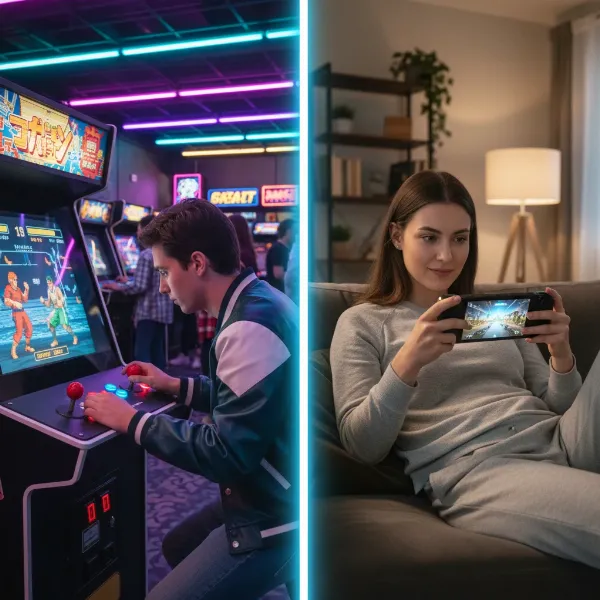 A split image showing a gamer playing an immersive arcade machine on one side and a person enjoying a handheld console on the other, highlighting the contrast in scale and environment.
The appeal of arcade machines is deeply rooted in their immersive and social nature. Large, vibrant screens, powerful audio systems, and specialized controls (like flight sticks, steering wheels, or light guns) create an unparalleled sensory experience that home setups often struggle to replicate. Arcades are inherently social spaces, fostering friendly competition and camaraderie among players and spectators alike. For many adults, arcades offer a powerful dose of nostalgia, reconnecting them with childhood memories. Beyond entertainment, playing arcade games has documented cognitive benefits, including enhanced hand-eye coordination, improved decision-making under pressure, better multitasking abilities, and stress relief. Many games feature simple, intuitive controls, making them accessible to gamers of all skill levels.
However, arcade machines also have significant drawbacks. Their immobility is a major limitation; they are fixed installations and cannot be taken on the go. Historically, playing required inserting coins per play, leading to potentially high costs over time. Owning a full-sized arcade cabinet for home use is a considerable investment, requiring substantial space and often complex maintenance for older machines. Unlike a modern handheld that can store hundreds of games, a single arcade cabinet typically offers only one or a few titles, limiting immediate variety. The decline in the number of traditional arcades, particularly in Western countries, means access can be limited.
Core Differences: Where Portability Meets Presence
The fundamental distinction between handheld game consoles and arcade machines lies in their very design philosophy: one prioritizes freedom and personal play, while the other champions shared, high-impact experiences.
| Feature | Handheld Game Consoles | Arcade Machines |
|---|---|---|
| Primary Advantage | Portability, Personal Play, Ownership | Immersion, Social Interaction, Unique Experiences |
| Mobility | Highly portable; play anywhere (commute, travel, home) | Immobile; fixed to specific public or private locations |
| Game Library | Vast, multi-game digital libraries; owned titles | Typically one or few games per cabinet; pay-per-play |
| Control Scheme | Integrated buttons, joysticks, touchscreens; generic | Specialized, robust, bespoke controls (e.g., fight sticks, light guns) |
| Screen Size | Small, integrated screens (typically 5-8 inches) | Large, dedicated screens (can be projection or multiple monitors) |
| Social Aspect | Online multiplayer, local co-op (nearby players); personal | In-person competition, shared spectating, communal experience |
| Cost Model | Upfront device purchase, game purchases; low operating costs | Per-play cost (quarters/tokens); high upfront for ownership |
| Immersion | Personal, close-up experience; relies on headphones/haptics | Full-body, sensory overload; dedicated cabinet design |
| Maintenance | Generally low for modern devices | Can be complex for older cabinets (hardware failures) |
Mobility vs. Immersion
|
Our Picks for the Best Handheld game console in 2026
As an Amazon Associate I earn from qualifying purchases.
|
||
| Num | Product | Action |
|---|---|---|
| 1 | Handheld Game for Kids -Preloaded 220 Retro Video Games, Portable Gaming Player with Rechargeable Battery 3.0" LCD Screen, Mini Arcade Electronic Toy Gifts for Boys Girls (Blue) |

|
| 2 | 32 Bit Handheld Games for Kids Preloaded 139 Video Games, Portable Video Gaming Player with 3.0" IPS Screen and Rechargeable Battery, Mini Travel Games Electronic Gifts Toys for Boys Girls, Blue |
|
| 3 | RG56PRO Retro Handheld Game Console - 5.5 Inch IPS Screen,31000+ Classic 3D Games,5000mAh Battery, Open Linux System,Portable Console with 128G TF Card - Birthday Gift for Boyfriend (Black) |
|
| 4 | Retro Handheld Game Console of Boy Portable Hand Held Video Games X9 Preloaded Wireless Juegos para Niños Stick TV Pixel Gaming for Kids Sf3000 Plug 'n' Play Drive Systems De Juegos Portátil |
|
| 5 | R36MAX Retro Handheld Game Console, 4.0 Inch IPS HD Screen Portable Retro Gaming Console, 1.5GHz CPU Support 30+ Emulator Console Video Game Console, 4000mAh Battery (64GB Black) |
|
| 6 | ASUS ROG Xbox Ally – 7” 1080p 120Hz Touchscreen Gaming Handheld, 3-month Xbox Game Pass Premium included, AMD Ryzen Z2 A, 16GB RAM, 512GB SSD, White |
|
| 7 | R36MAX Handheld Game Console - 4.0-Inch Screen, Support 22000+Classic Games,128G TF Card,Portable Console with Open Source System,4000mAh Battery,Birthday Gift for Adult or Partner - Black |
|
| 8 | Handheld Game for Kids -Preloaded 220 Retro Video Games, Portable Gaming Player with Rechargeable Battery 3.0" LCD Screen, Mini Arcade Electronic Toy Gifts for Boys Girls (Red) |
|
| 9 | R36MAX Retro Handheld Game Console, 4.0 Inch 720x720 IPS Screen, 64GB Built-in 18,000+ Classic Game, Portable Hand Held Open Source Linux System, 4000mAh Battery Retro Gaming Console(White 64GB) |
|
| 10 | R36MAX Retro Handheld Game Console, 4.0 Inch 720x720 IPS Screen, 64GB Built-in 18,000+ Classic Game, Portable Hand Held Open Source Linux System, 4000mAh Battery Retro Gaming Console(Black 64GB) |
|
Handhelds undeniably win the battle for mobility, offering the ultimate freedom to game wherever life takes you. This freedom is perfect for gamers who want to squeeze in a quick session during downtime or continue their adventure uninterrupted while traveling. On the other hand, arcade machines are the undisputed champions of raw, unadulterated immersion. The sheer scale of the cabinet, the specialized controls, and often the powerful sound systems create an all-encompassing experience that can be breathtaking. It’s about stepping into a dedicated gaming sanctuary, even if for just a few minutes.
Game Libraries & Cost
When it comes to the breadth and ownership of game libraries, handheld game consoles take a clear lead. Modern handhelds, particularly those with digital storefronts, offer access to hundreds, if not thousands, of titles across various genres. Once purchased, these games are yours to keep and play indefinitely. Arcade machines, by design, traditionally offer a limited selection per cabinet, often just one game. While this singularity of purpose can lead to incredibly refined experiences, the cost per play model means enjoyment is often fleeting unless you own a machine yourself. The significant upfront cost of owning an arcade cabinet often makes it a niche pursuit.
Control Schemes
The control schemes represent another crucial divergence. Handheld consoles provide ergonomic, integrated controls that are versatile enough for many game types. While highly functional, these are typically standardized. Arcade machines, however, often feature bespoke, robust controls engineered specifically for the game they house. Imagine the precise, satisfying clunk of an arcade joystick or the tactile feedback of oversized buttons for a fighting game. These specialized inputs offer a level of physical engagement and precision that generic handheld controls cannot fully replicate for certain genres.
Social Dynamics
Both platforms offer social interaction, but in fundamentally different ways. Handheld consoles facilitate social connections primarily through online multiplayer, allowing friends to play together regardless of geographical distance. Some also support local wireless play, bringing players together in close proximity. Arcade machines, conversely, are the epitome of in-person social gaming. They thrive on the shared experience of standing side-by-side, competing for high scores, or collaborating on a challenging game. The energy of an arcade, with its bustling sounds and cheering crowds, fosters a unique communal atmosphere that is hard to match.
The Technological Evolution: From Pixels to Powerhouses
Both handheld game consoles and arcade machines have undergone remarkable technological transformations, continuously pushing the boundaries of what’s possible in gaming. Early arcade machines, like Pong, used rudimentary electronic circuitry, while early handhelds were limited to simple LED displays. However, each platform has evolved to leverage cutting-edge technology.
In the handheld realm, the progression from monochromatic screens to vibrant color displays, and then to high-resolution OLED panels, mirrors the rapid advancements in mobile technology. The integration of powerful CPUs and GPUs, initially reserved for home consoles, into compact portable devices has blurred the lines, allowing handhelds to run demanding AAA titles with impressive graphical fidelity. Modern handheld PCs, such as the Steam Deck and Asus ROG Ally, are essentially portable gaming computers, capable of running a vast library of PC games with high refresh rates and advanced features. These devices often feature hybrid designs, allowing them to connect to TVs for a larger-screen experience, bridging the gap between portable and home console gaming.
Arcade technology has also evolved beyond simple coin-ops. While classic cabinets still hold immense appeal, modern arcades often incorporate advanced motion simulators, virtual reality (VR) experiences, and elaborate interactive installations. Contemporary “barcades” combine the nostalgia of retro arcade games with modern social venues, providing a curated experience that focuses on community and entertainment. The emphasis has shifted from pure graphical horsepower (which home consoles and PCs now dominate) to unique, physical, and highly immersive experiences that are difficult to replicate at home.
“The magic of an arcade isn’t just in the game, it’s in the entire sensory overload – the bright lights, the booming sounds, the unique controls that become an extension of your will. It’s a feeling that’s truly hard to bottle and take home.” – Sarah Chen, Gaming Historian and Consultant
Declaring the Winners: Best for Every Gamer
When comparing handheld game consoles and arcade machines, it’s not about an absolute “winner,” but rather which platform excels in specific scenarios and caters best to individual preferences. Each offers a distinct value proposition.
Winner for Portability: Handheld Game Consoles
This is an undeniable victory for handheld game consoles. Devices like the Nintendo Switch, Steam Deck, and even the Analogue Pocket for retro enthusiasts are designed specifically for gaming on the go, allowing players to pick up and play wherever they are. Their compact size and integrated controls make them perfect companions for travel, commuting, or simply moving from room to room at home.
Winner for Immersive Experience: Arcade Machines
For sheer, unadulterated immersion, arcade machines take the crown. The combination of large, dedicated screens, powerful sound systems, and often unique, haptic-feedback enabled controls creates a sensory experience that pulls players deep into the game world. You’re not just playing; you’re often physically interacting with a finely tuned machine, whether it’s a racing simulator or a dance game.
Winner for Game Variety & Ownership Value: Handheld Game Consoles
Handhelds offer a colossal advantage in game variety. A single modern handheld can access vast digital libraries, featuring thousands of titles from various eras and genres. Once purchased, these games are owned and can be replayed indefinitely. While arcade machines offer unique titles, their per-cabinet game selection is limited, and the cost of ownership for a home cabinet is substantial.
Winner for Social Interaction & Community: Arcade Machines
Arcade machines foster a unique, in-person social dynamic that handhelds, even with online multiplayer, struggle to replicate. The act of playing alongside friends, challenging strangers, or cheering on fellow gamers creates a vibrant, communal atmosphere. It’s an outward, shared experience, unlike the often more solitary or online nature of handheld gaming.
Winner for Unique Control Schemes: Arcade Machines
Arcades excel when it comes to specialized and bespoke control mechanisms. From flight sticks to elaborate racing wheels, light guns, or rhythm game peripherals, arcade machines often integrate hardware that is perfectly tailored to their specific game. These unique interfaces provide a tactile and engaging experience that is difficult to replicate with generic handheld controllers.
Winner for Personal, Uninterrupted Play: Handheld Game Consoles
For gamers who crave a private, focused, and uninterrupted experience, handheld game consoles are the superior choice. You can delve into a game without external distractions, notifications, or the need to share a screen. This intimate connection with the game world, often with the screen just inches from your eyes, can be incredibly engaging for certain genres.
Making Your Choice: A Gamer’s Personal Guide
Deciding between a handheld game console and an arcade machine (or rather, choosing where to invest your gaming time and resources) boils down to your personal preferences and lifestyle. Neither is inherently “better”; they simply offer different kinds of joy.
Consider these questions when making your choice:
- What are your gaming habits? Do you prefer short, spontaneous bursts of play or longer, dedicated sessions?
- Where do you typically game? Are you often on the go, or do you have a dedicated space at home?
- What kind of games do you enjoy most? Are you drawn to narrative-driven adventures, competitive multiplayer, retro classics, or unique physical experiences?
- What is your budget? Are you looking for an affordable entry point, or are you prepared for a significant investment?
- How important is the social aspect? Do you thrive on in-person group interactions, or do you prefer online connections and solo play?
If portability, a vast personal game library, and the convenience of gaming anywhere are your top priorities, a modern handheld game console is likely your best bet. Options range from the versatile Nintendo Switch to the powerful PC-centric Steam Deck, offering a wide array of experiences.
If, however, you seek an immersive, larger-than-life experience, unique physical controls, and the thrill of communal play, then visiting an arcade or even investing in a home arcade setup might be more appealing. Modern arcades and “barcades” provide a vibrant social atmosphere that can be deeply satisfying for group outings and competitive spirits.
Ultimately, many gamers find joy in both. The rise of hybrid consoles and the availability of retro arcade emulation on handhelds show a convergence, allowing players to appreciate the best of both worlds.
Conclusion
The enduring debate between handheld game consoles and arcade machines is less about finding a single victor and more about celebrating the rich diversity of interactive entertainment. Handhelds have revolutionized personal gaming, offering unparalleled portability, diverse game libraries, and the freedom to play anywhere. They are the champions of convenience and individual engagement. Arcade machines, with their immersive cabinets and specialized controls, deliver grand, social spectacles that evoke powerful nostalgia and foster real-world connections. They are the winners of raw spectacle and communal joy. Each platform provides a distinct, valuable slice of gaming history and innovation. By understanding their unique strengths, you can embrace the form of play that best resonates with your gaming spirit, or perhaps, like many enthusiasts, find a way to enjoy the best of both worlds. Which gaming champion will you choose to power your next adventure?
Frequently Asked Questions
What are the main benefits of playing on a handheld game console?
Handheld game consoles offer significant benefits including unparalleled portability, allowing you to play games anywhere and anytime. They provide a personal and uninterrupted gaming experience, often with physical controls for precise input, and access to vast game libraries. Many are also relatively affordable and efficient to operate.
How do modern arcade experiences differ from classic ones?
Modern arcade experiences, often found in “barcades” or entertainment centers, frequently incorporate advanced technologies like virtual reality, elaborate motion simulators, and highly interactive installations. While still offering classic coin-op games, they emphasize a curated social environment, often combining gaming with dining and other entertainment to create a holistic outing experience.
Is owning an arcade machine a good investment for a home?
Owning an arcade machine can be a rewarding investment for enthusiasts seeking nostalgia, a unique piece of collectible decor, and a distinctive social centerpiece for their home. However, it requires significant upfront cost, considerable space, and potential maintenance for older units. Its value is more sentimental and experiential than financial for most.
Can handheld consoles truly replicate the arcade experience?
While modern handheld consoles can emulate many classic arcade games and offer impressive graphics and performance, they cannot fully replicate the physical, immersive, and social experience of a dedicated arcade machine. The smaller screen, generic controls, and lack of a bustling public environment distinguish it from the true arcade feel.
Which platform is better for competitive gaming?
For in-person, local competitive gaming with an audience and unique controls (like fighting game cabinets), arcade machines often provide a superior, high-energy experience. For online, global competitive gaming, handheld consoles (especially those with robust online infrastructure like the Nintendo Switch or PC handhelds) are better suited due to their connectivity and vast player bases.