In today’s fast-paced world, finding common ground for family entertainment can be a delightful challenge. The realm of video games, once confined to living room consoles, has blossomed into a vibrant ecosystem of portable powerhouses. Handheld game consoles offer a unique blend of personal escape and shared joy, making them an increasingly popular choice for families seeking versatile entertainment. But with a plethora of options available, from dedicated gaming devices to versatile portable PCs, selecting the perfect handheld for everyone in your household can feel like navigating a complex maze. This guide is designed to cut through the confusion, offering a comprehensive look at the best handheld game consoles for the entire family, helping you make an informed decision that brings everyone together.
What is a Handheld Game Console?
A handheld game console is a compact, portable electronic device designed primarily for playing video games. Unlike smartphones or tablets that offer gaming as one of many features, handheld consoles are purpose-built for gaming, often featuring dedicated controls, specialized hardware, and a robust library of titles. Their history traces back to the iconic Game Boy, evolving through generations of devices like the Nintendo DS and PlayStation Portable, to today’s sophisticated machines that can rival the graphical fidelity of home consoles and even PCs. The key distinction lies in their optimized design for gaming on the go, providing a focused, immersive experience without the distractions of other mobile applications.
Why Choose a Handheld Game Console?
Choosing a handheld game console for your family offers several compelling advantages, alongside a few considerations to keep in mind.
Advantages:
- Mobility and Convenience: The most obvious benefit is the ability to play anywhere. Whether it’s a long car ride, a flight, a waiting room, or simply moving from one room to another, handhelds provide entertainment on demand. This portability makes them ideal for travel or for keeping children engaged during errands.
- Dedicated Gaming Experience: Unlike multi-purpose devices, handheld consoles offer an uncompromised gaming experience. They boast physical buttons, joysticks, and triggers that provide tactile feedback and precision superior to touchscreen controls. This dedicated design allows for deeper immersion and more satisfying gameplay.
- Exclusive Game Libraries: Many handhelds, particularly Nintendo’s offerings, feature exclusive first-party titles that are often family-friendly and highly acclaimed. These games provide unique experiences that cannot be found on other platforms, offering compelling reasons to invest in a specific system.
|
Our Picks for the Best Handheld game console in 2026
As an Amazon Associate I earn from qualifying purchases.
|
||
| Num | Product | Action |
|---|---|---|
| 1 | Handheld Game for Kids -Preloaded 220 Retro Video Games, Portable Gaming Player with Rechargeable Battery 3.0" LCD Screen, Mini Arcade Electronic Toy Gifts for Boys Girls (Red) |

|
| 2 | 32 Bit Handheld Games for Kids Preloaded 139 Video Games, Portable Video Gaming Player with 3.0" IPS Screen and Rechargeable Battery, Mini Travel Games Electronic Gifts Toys for Boys Girls, Blue |
|
| 3 | R36MAX Handheld Game Console - 4.0-Inch Screen, Support 22000+Classic Games,128G TF Card,Portable Console with Open Source System,4000mAh Battery,Birthday Gift for Adult or Partner - Black |
|
| 4 | Retro Handheld Game Console of Boy Portable Hand Held Video Games X9 Preloaded Wireless Juegos para Niños Stick TV Pixel Gaming for Kids Sf3000 Plug 'n' Play Drive Systems De Juegos Portátil |
|
| 5 | R36MAX Retro Handheld Game Console, 4.0 Inch 720x720 IPS Screen, 64GB Built-in 18,000+ Classic Game, Portable Hand Held Open Source Linux System, 4000mAh Battery Retro Gaming Console(Black 64GB) |
|
| 6 | Handheld Game for Kids -Preloaded 220 Retro Video Games, Portable Gaming Player with Rechargeable Battery 3.0" LCD Screen, Mini Arcade Electronic Toy Gifts for Boys Girls (Blue) |
|
| 7 | R36MAX Retro Handheld Game Console, 4.0 Inch 720x720 IPS Screen, 64GB Built-in 18,000+ Classic Game, Portable Hand Held Open Source Linux System, 4000mAh Battery Retro Gaming Console(White 64GB) |
|
| 8 | R36MAX Retro Handheld Game Console, 4.0 Inch IPS HD Screen Portable Retro Gaming Console, 1.5GHz CPU Support 30+ Emulator Console Video Game Console, 4000mAh Battery (64GB Black) |
|
| 9 | ASUS ROG Xbox Ally – 7” 1080p 120Hz Touchscreen Gaming Handheld, 3-month Xbox Game Pass Premium included, AMD Ryzen Z2 A, 16GB RAM, 512GB SSD, White |
|
| 10 | RG56PRO Retro Handheld Game Console - 5.5 Inch IPS Screen,31000+ Classic 3D Games,5000mAh Battery, Open Linux System,Portable Console with 128G TF Card - Birthday Gift for Boyfriend (Black) |
|
Disadvantages:
- Potentially Higher Cost: While some budget-friendly options exist, high-end handhelds can be a significant investment, often comparable to or exceeding the price of a traditional home console. The cost of games and accessories also adds up.
- Performance Limitations: Although modern handhelds are powerful, their compact size means they generally cannot match the raw processing power or graphical fidelity of high-end gaming PCs or current-generation home consoles. This might mean compromises in graphics settings or frame rates for demanding AAA titles.
Popular Types of Handheld Game Consoles
The handheld market is diverse, catering to different preferences and gaming styles. Here are some of the most popular categories and their leading contenders.
Nintendo Switch (Including Switch 2, OLED, and Lite)
The Nintendo Switch remains a dominant force, especially for families, due to its hybrid nature. It seamlessly transitions from a portable handheld to a home console by docking it to a TV. The Nintendo Switch OLED model enhances this experience with a vibrant OLED screen, improved kickstand, and enhanced audio, making games look stunning whether played solo or with others. The newer Nintendo Switch 2 is expected to build on this legacy with upgraded performance and features, while maintaining backward compatibility with older Switch games and accessories. For those on a tighter budget or primarily interested in handheld play, the Nintendo Switch Lite offers a more compact, integrated design, though it sacrifices TV-out functionality and detachable Joy-Cons. Its robust library of first-party, family-friendly games like Mario Kart, Pokémon, and The Legend of Zelda makes it a top choice for households with diverse gaming tastes.
Steam Deck (OLED)
Valve’s Steam Deck carved out a new niche by bringing PC gaming into a portable form factor. The Steam Deck OLED improves upon the original with a larger, more vibrant OLED display, extended battery life, and reduced weight, making it an even more attractive option. It grants access to a vast library of PC games from your Steam account, including many indie gems and graphically demanding AAA titles. While not explicitly designed for “family” play in the same way as the Switch, its versatility allows individual family members who are PC gamers to enjoy their extensive libraries on the go.
AYANEO, ASUS ROG Ally, and Lenovo Legion Go (Windows-based Handheld PCs)
This category represents the high-performance segment of handheld gaming, essentially miniaturized gaming PCs. Devices like the ASUS ROG Ally X and Lenovo Legion Go S boast powerful AMD Ryzen processors, capable of running demanding Windows games from various launchers, including Xbox Game Pass, Steam, and Epic Games Store. They typically feature high-resolution, high-refresh-rate screens and offer extensive customization options. The Legion Go, in particular, offers a large display and detachable controllers, reminiscent of the Switch’s versatility but with PC-level power. These are ideal for families where members desire cutting-edge performance and access to a broader PC game library, though they come with a higher price tag and potentially more complexity than console-like handhelds.
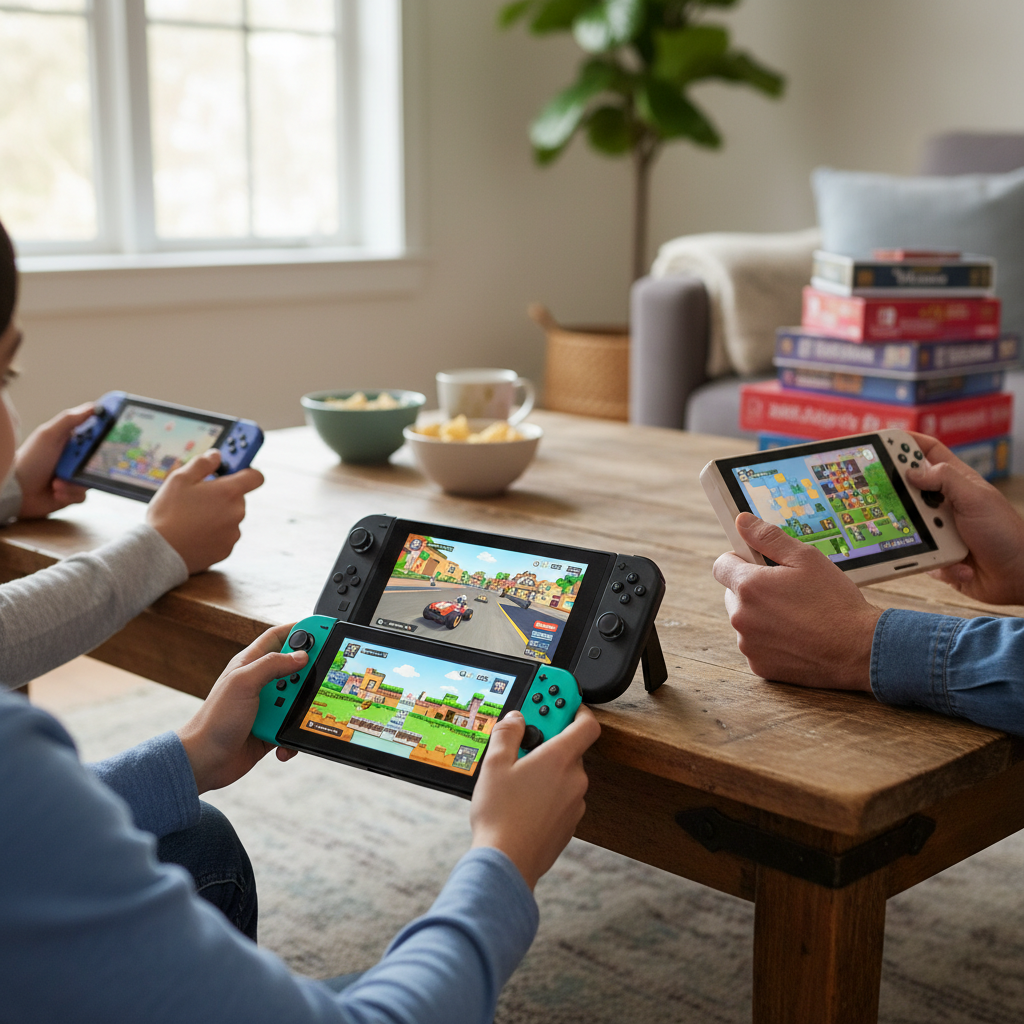
[image-1|handheld-game-consoles-family-choice|A family enjoying various handheld game consoles together in a cozy living room, illustrating different types of devices and shared moments.|
A diverse family (parents, two children aged 8-14) is spread out on a comfortable couch and floor in a modern, warm-toned living room, each absorbed in a different handheld game console. One parent holds a Nintendo Switch, another a Steam Deck, one child plays on an ASUS ROG Ally, and the younger child uses a retro handheld. Soft, natural light fills the room, and the scene emphasizes connection and shared enjoyment despite individual devices. The style is realistic and inviting.]
Other Choices: Retroid Pocket, Anbernic, Powkiddy (Retro and Emulation Handhelds)
For families with a fondness for nostalgia or those seeking a budget-friendly entry point, retro handhelds offer a charming alternative. Brands like Retroid Pocket, Anbernic, and Powkiddy specialize in devices capable of emulating classic games from past console generations. These often come pre-loaded with hundreds or thousands of retro titles, appealing to parents reminiscing about their childhoods and introducing younger kids to gaming history. They typically have simpler controls and can be quite durable, making some models excellent first handhelds for younger children.
Comparison of Popular Handheld Game Consoles
To help you weigh your options, here’s a detailed comparison of some leading handheld game consoles. Note that specifications can vary between models and generations (e.g., Switch OLED vs. Switch Lite).
| Feature | Nintendo Switch 2 (Expected) | Steam Deck OLED | ASUS ROG Ally X | Retroid Pocket 4 Pro (Example Retro) |
|---|---|---|---|---|
| CPU | Octa-core ARM Cortex-A78C | Custom AMD APU (Zen 2) | AMD Ryzen Z2 Extreme | MediaTek Dimensity 1100 |
| GPU | Custom Nvidia Ampere | RDNA 2 | AMD Radeon RDNA 3.5 | ARM Mali-G77 MC9 |
| RAM | 12GB LPDDR5 | 16GB LPDDR5 | 24GB LPDDR5X | 8GB LPDDR4X |
| Storage | 256GB (Internal) | Up to 1TB NVMe SSD | 1TB NVMe SSD | 128GB (Internal) |
| Display | 10.7 x 4.5 x 0.6 in, 4K/HDR | 7.4-inch OLED, 1280×800 | 7-inch IPS, 1920×1080 | 4.7-inch IPS, 750×1334 |
| Battery Life | Shorter than old Switch | 3-12+ hours | 3-6+ hours | 5-8+ hours |
| Operating System | NintendoOS | SteamOS (Linux-based) | Windows 11 Home | Android 11 |
| Key Features | Hybrid (TV/Handheld), Detachable Joy-Cons, Family-friendly exclusives | Full PC game library, Trackpads, Ergonomic design, High customization | Windows ecosystem, High performance, Multiple launchers, Advanced cooling | Android apps, Extensive retro emulation, Compact size, Affordable |
| Price (approx.) | $400-550 | $549 – $649 | $799 – $899 | $199 |
Buying Guide: How to Choose the Right Handheld Game Console
Selecting the best handheld for your family requires a thoughtful evaluation of your specific needs and priorities. Consider these factors:
Determine Your Family’s Gaming Needs
- What games do you want to play? If your family loves Nintendo’s exclusive franchises (Mario, Zelda, Pokémon), a Switch is non-negotiable. For PC gamers, the Steam Deck or a Windows handheld opens up vast libraries. If retro classics are the goal, a dedicated emulation device might be perfect.
- What level of performance do you need? For casual gaming and most indie titles, the Switch or even retro handhelds suffice. For demanding AAA games, a Steam Deck or ROG Ally X will provide a better experience.
- How important is portability and ease of use? The Switch’s “pick up and play” nature and detachable controllers make it incredibly family-friendly. Windows handhelds can be more complex due to the underlying operating system.
- What’s your budget? Handhelds range significantly in price. The Switch Lite offers an affordable entry, while high-performance PC handhelds can be expensive investments. Consider not just the console price but also game costs and necessary accessories.
Key Factors to Consider
- Performance (CPU, GPU, RAM): This dictates how well games run. Higher specs are needed for modern AAA titles, while lower specs are fine for indie and retro games.
- Screen Quality: Look for size, resolution, and panel type (OLED offers superior contrast and colors). A larger screen can be better for shared viewing, while a smaller, vibrant screen is great for individual play.
- Battery Life: Essential for portability. Check reviews for real-world battery performance, especially for demanding games.
- Game Library and Ecosystem: This is crucial. Nintendo offers exclusive, family-friendly content. Steam Deck taps into the massive Steam library. Windows handhelds access nearly all PC games. Retro handhelds offer thousands of classic titles.
- Operating System: Nintendo Switch runs on a custom, user-friendly OS. Steam Deck uses SteamOS (Linux-based), tailored for gaming. ROG Ally and Legion Go run full Windows, offering flexibility but also potential complexity.
- Ergonomics and Durability: For a family device, comfort during long play sessions and robust build quality (especially if young children will be using it) are important.
Advice for Different User Groups
- For Casual Gamers and Younger Children: The Nintendo Switch (any model) is often the best choice due to its ease of use, family-friendly game library, and local multiplayer options.
- For PC Gamers in the Family: The Steam Deck OLED or a powerful Windows handheld like the ROG Ally X provides access to extensive PC libraries on the go.
- For Budget-Conscious Families or Retro Enthusiasts: A Nintendo Switch Lite or a dedicated retro emulation device offers great value and hours of classic fun.
“When choosing a family handheld, consider the lowest common denominator – if your youngest child can pick it up and intuitively enjoy a game, it’s probably a good fit for everyone.” – Sarah Jenkins, Family Tech Reviewer.
Top Picks: Best Handheld Game Consoles for Families
Based on versatility, game library, ease of use, and overall family appeal, here are our top recommendations:
Best Overall: Nintendo Switch OLED
The Nintendo Switch OLED is a phenomenal choice for families. Its hybrid nature allows for seamless switching between handheld mode for personal play and docked mode for shared gaming on the TV. The vibrant OLED screen makes games pop, and the detachable Joy-Cons enable instant local multiplayer. Nintendo’s vast library of first-party titles is unparalleled for family-friendly fun, with games suitable for all ages and skill levels.
Best for Performance and PC Gamers: Steam Deck OLED or ASUS ROG Ally X
If your family includes members who are serious PC gamers or who demand the highest performance for modern AAA titles, the Steam Deck OLED or ASUS ROG Ally X are excellent. The Steam Deck provides a console-like experience for your Steam library, while the ROG Ally X offers the full Windows ecosystem, allowing access to a broader range of storefronts and applications. Both deliver impressive power in a portable package.
Best Budget-Friendly/Retro Option: Nintendo Switch Lite or Anbernic RG35XX Plus
For families looking for a more affordable option or those who revel in retro gaming, the Nintendo Switch Lite is a fantastic choice, offering access to the entire Switch game library in a compact, durable, and budget-friendly handheld-only form. Alternatively, for pure retro enjoyment, a device like the Anbernic RG35XX Plus provides an authentic classic gaming experience with a massive library of emulated titles at a very accessible price point.
Tips and Tricks for Using Your Handheld Game Console
To get the most out of your family’s handheld, consider these practical tips:
- Optimize Performance and Battery Life: Most modern handhelds allow you to adjust performance settings. Lowering graphics or screen brightness can significantly extend battery life, crucial for longer trips. Many devices also offer specific “power-saving” modes.
- Install and Manage Games: Familiarize yourself with how to download, install, and update games on your chosen console. For systems like the Switch, a microSD card is often essential for expanding storage. Windows-based handhelds require managing multiple game launchers.
- Connect to a TV and External Devices: For multiplayer fun, learn how to connect your handheld to a TV (if supported). The Switch includes a dock, while others might require a separate USB-C hub or dock. Consider external controllers for more players, or quality headphones for immersive solo sessions.
- Troubleshooting Common Issues: Know how to perform a hard reset, check for software updates, and utilize online resources for common problems. Regular updates can fix bugs and improve performance.
Essential Handheld Game Console Accessories
Enhance your family’s gaming experience with these useful accessories:
- Protective Case and Screen Protector: An absolute must, especially for devices used by children. A good case protects against drops and scratches, while a screen protector guards against scuffs.
- Memory Card: For consoles like the Nintendo Switch or Windows handhelds, expandable storage via a microSD card is often necessary to house a growing game library.
- Portable Power Bank: Extend your playtime on the go. A high-capacity power bank ensures your handheld never runs out of juice during travel or long play sessions.
- Extra Controllers (for Switch/Legion Go): For the Nintendo Switch, an extra set of Joy-Cons or a Pro Controller can facilitate more local multiplayer. The Legion Go also benefits from additional controllers for shared play.
- Headphones: Essential for immersive solo gaming, allowing players to focus on their game without disturbing others.
- Dock or USB-C Hub (for Steam Deck/Windows handhelds): If you plan to connect PC-based handhelds to a TV, a dock or hub is needed for video output and connecting peripherals.
Conclusion
Choosing the best handheld game console for your entire family is an exciting journey that balances performance, game variety, ease of use, and budget. While powerful devices like the Steam Deck OLED and ASUS ROG Ally X cater to serious gamers with vast PC libraries, the Nintendo Switch OLED stands out as the quintessential family-friendly option, offering unparalleled versatility, a treasure trove of exclusive games for all ages, and seamless transitions between individual and shared play. Retro handhelds also provide excellent value for nostalgic parents and curious kids alike.
Ultimately, the perfect handheld is one that aligns with your family’s unique gaming preferences and lifestyle. By carefully considering the factors discussed in this guide, you can confidently select a device that brings endless hours of portable fun and shared memories to everyone. What kind of adventures will your family embark on with your new handheld companion?
Frequently Asked Questions
Which handheld game console has the most family-friendly games?
The Nintendo Switch, including the Switch OLED and upcoming Switch 2, has the most extensive library of family-friendly games due to Nintendo’s focus on accessible first-party titles like Mario, Zelda, and Pokémon that appeal to a wide range of ages.
Can a Steam Deck be used by children, or is it too complicated?
While capable of running many games, the Steam Deck’s Linux-based SteamOS and access to a broad PC game library might be more complex for very young children or casual users compared to the more straightforward interface of a Nintendo Switch.
What is the best handheld console for long car rides?
The Nintendo Switch OLED or Steam Deck OLED are excellent for long car rides due to their large, vibrant screens and good battery life. The Switch’s ability to detach controllers and use “Tabletop Mode” can also be beneficial for shared viewing.
Are retro handheld consoles durable enough for kids?
Some retro handhelds, like certain Anbernic models (e.g., RG280V), are known for their robust build quality and compact size, making them quite durable and suitable for older children. However, build quality varies, so it’s essential to check reviews for specific models.
How important is screen quality for a family handheld?
Screen quality is very important, especially for shared experiences or diverse age groups. A clear, vibrant display (like an OLED) enhances immersion and makes games more enjoyable for everyone, reducing eye strain during longer play sessions.